
 What Summer Humidity Is Quietly Doing To Your Older Greater Boston Home
Sometime around the second week of July, the air in Sharon changes character.
It stops being warm and starts being heavy. You feel it when you open the basement door and get that cool, damp, slightly-mineral smell that was not there in April. Across Norfolk County and the greater Boston metro, that shift begins the most active season for moisture damage in older New England homes — and almost none of it announces itself while it is happening.
Homeowners tend to think of moisture as a spring problem — snowmelt, April rain, a wet week in March. But the damage that shows up in a Metro Boston Property Inspections report in October usually started in July, in a basement nobody visited, at a temperature and humidity combination that made condensation inevitable.
Here is what is going on, and what to do about it.
Why Does Summer Humidity Hit Older Greater Boston Homes So Hard?
Because older homes were built to breathe, and summer air in eastern Massachusetts carries more water than those assemblies were ever asked to handle.
A post-and-beam farmhouse in Sharon, a balloon-framed Victorian in Stoughton, a 1920s colonial in Canton or Norwood — all were built with continuous air paths from foundation to roof. Uninsulated cavities dried fast, and coal or oil heat running eight months a year kept everything bone dry. Then came blown-in insulation, replacement windows, weatherstripping and central air. We tightened the envelope without changing the drying path.
The result is a house that still moves air vertically like a chimney but no longer dries the way it once did.
What Is Dew Point, And Why Does It Matter More Than The Humidity Percentage?
Dew point is the temperature at which air can no longer hold its moisture — and it tells you far more about summer damage risk than relative humidity does.
Relative humidity moves all day as temperature moves; dew point does not. At about 65°F most people call the air sticky; at 70°F and above it is genuinely oppressive. In a typical greater Boston July and August, dew points in the mid-60s to low 70s are ordinary, and the sea breeze off Massachusetts Bay pushes marine moisture inland across Norfolk County on exactly the days it already feels worst.
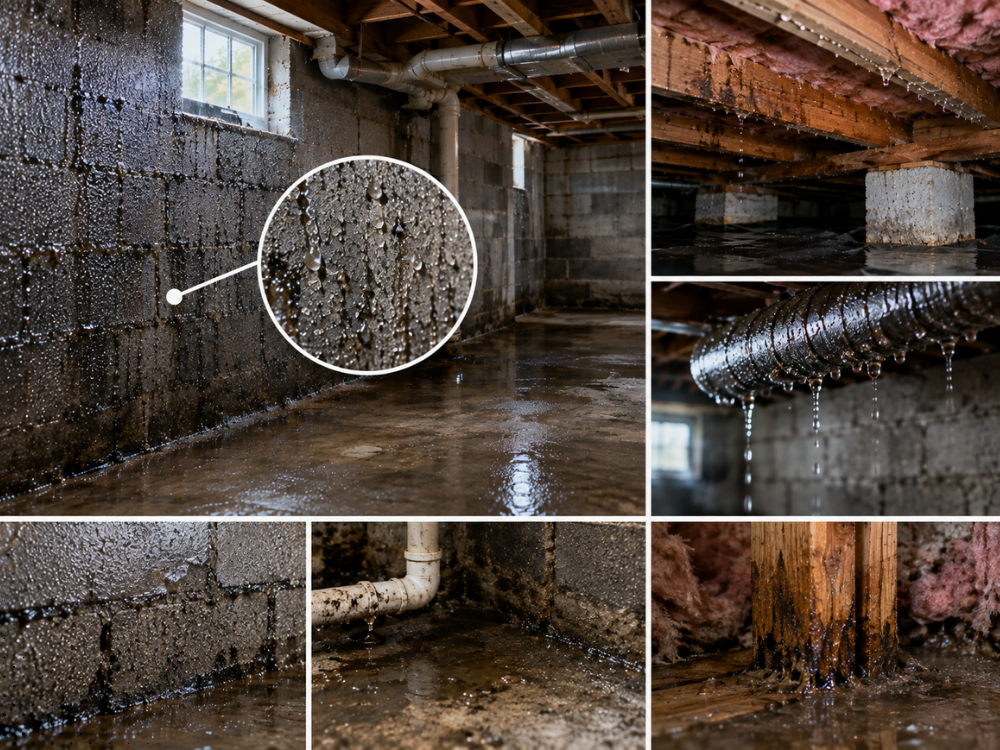
Here is why that number matters: anything in your house colder than the dew point will grow condensation. Not might — will. A fieldstone or rubble foundation wall sits at roughly 55 to 62°F all summer, because the surrounding earth is that temperature. When 72°F dew-point air reaches that wall, water forms on it. The wall is not leaking. The air is unloading.
Why Does Opening the Basement Windows Make Everything Worse?
Because you are feeding the problem rather than venting it — the most common and most costly summer mistake we see in older greater Boston basements.
The instinct is reasonable: the basement smells musty, so you open a window. But you have just invited 72-degree dew-point air into a 58-degree stone room, where it condenses on the fieldstone, the slab, cold copper lines and stored cardboard. By August that basement can run 70 to 80 percent relative humidity — the range where mold germinates and wood starts holding enough moisture to interest decay fungi.
Do the opposite. Keep basement windows and bulkheads closed through the humid stretch. Run a dehumidifier sized for the square footage, set to 45 to 50 percent relative humidity, with the hose routed to a floor drain or the sump pit. Put an inexpensive hygrometer on a shelf away from the wall.
White powdery deposits on stone or block are efflorescence — mineral salts left by water moving through the wall. A symptom, not a stain, and worth flagging to your inspector.
 What Is Summer Humidity Doing To Your Crawl Space?
In a vented crawl space, summer humidity does more damage than winter cold ever did — and the vents are the reason.
Older homes around Norfolk County frequently have a crawl space with foundation vents and a dirt or partially-poured floor. The theory was that outside air dries the space. In a humid coastal climate the opposite happens: warm June-through-September air enters the vents, meets cool joists and subfloor, and condenses on the underside of the floor you walk on. Wood that stays above roughly 20 percent moisture content is wood that rot fungus can live in. That is how sill plates and joist ends fail — slowly, from below, in the season nobody thinks about.
Watch for a musty odor rising through first-floor closets, cupping in hardwood, insulation batts sagging out of the joist bays, and dark staining on the subfloor. Standing water on a dirt floor means the ground vapor barrier is missing or torn. A properly lapped and sealed vapor barrier over exposed soil is one of the highest-value, lowest-cost improvements on an older home in this region.
Can Attic Ventilation Actually Make A Humid Summer Worse?
Yes — when the ventilation is unbalanced, or when humid indoor air reaches the attic faster than the vents can carry it away.
Attic ventilation only works as a system: intake at the soffits, exhaust at the ridge, clear path between. In older greater Boston homes that path is routinely blocked — insulation stuffed into soffit bays during an energy retrofit, or a ridge vent installed over a deck never fully cut open.
The bigger summer issue is what arrives from below. Bath fans that terminate in the attic instead of through the roof dump gallons of shower moisture into the rafters over a season. And in a balloon-framed home, wall cavities run uninterrupted from sill to attic floor, so damp basement air travels straight up inside the walls. That is why an attic can show rusted nail tips, dark sheathing stains or matted insulation in a house with no roof leak at all.
The fixes are unglamorous and effective: confirm every bath and kitchen fan exhausts outside, keep soffit baffles open, and control basement humidity so there is less moisture to travel.
What Should A Norfolk County Homeowner Do Between June And September?
Control the source, watch the numbers, and check the three places you never go.
Keep the dehumidifier running and the basement closed. Check the air conditioning condensate line — a clogged line backs up into a pan and then into a ceiling. Walk the crawl space and the attic once in July with a flashlight. Keep grading and downspouts moving water away from the foundation, because saturated soil against a fieldstone wall is a humidity source all season.
None of this is dramatic, and that is the point. Summer moisture damage in older homes is cumulative and quiet — and completely manageable when someone is paying attention in June rather than discovering it in October.
If you want a documented set of professional eyes on the moisture picture in your home — foundation, crawl space, attic ventilation, and everything connecting them — Tod Whiting at Metro Boston Property Inspections handles exactly this walkthrough for homeowners across Sharon, Norfolk County, and the greater Boston metro.
Ready to schedule your inspection? Call Tod directly at (781) 828-1972 or visit https://metrobostonpropertyinspections.com/ to schedule a maintenance inspection before the humid stretch peaks.